

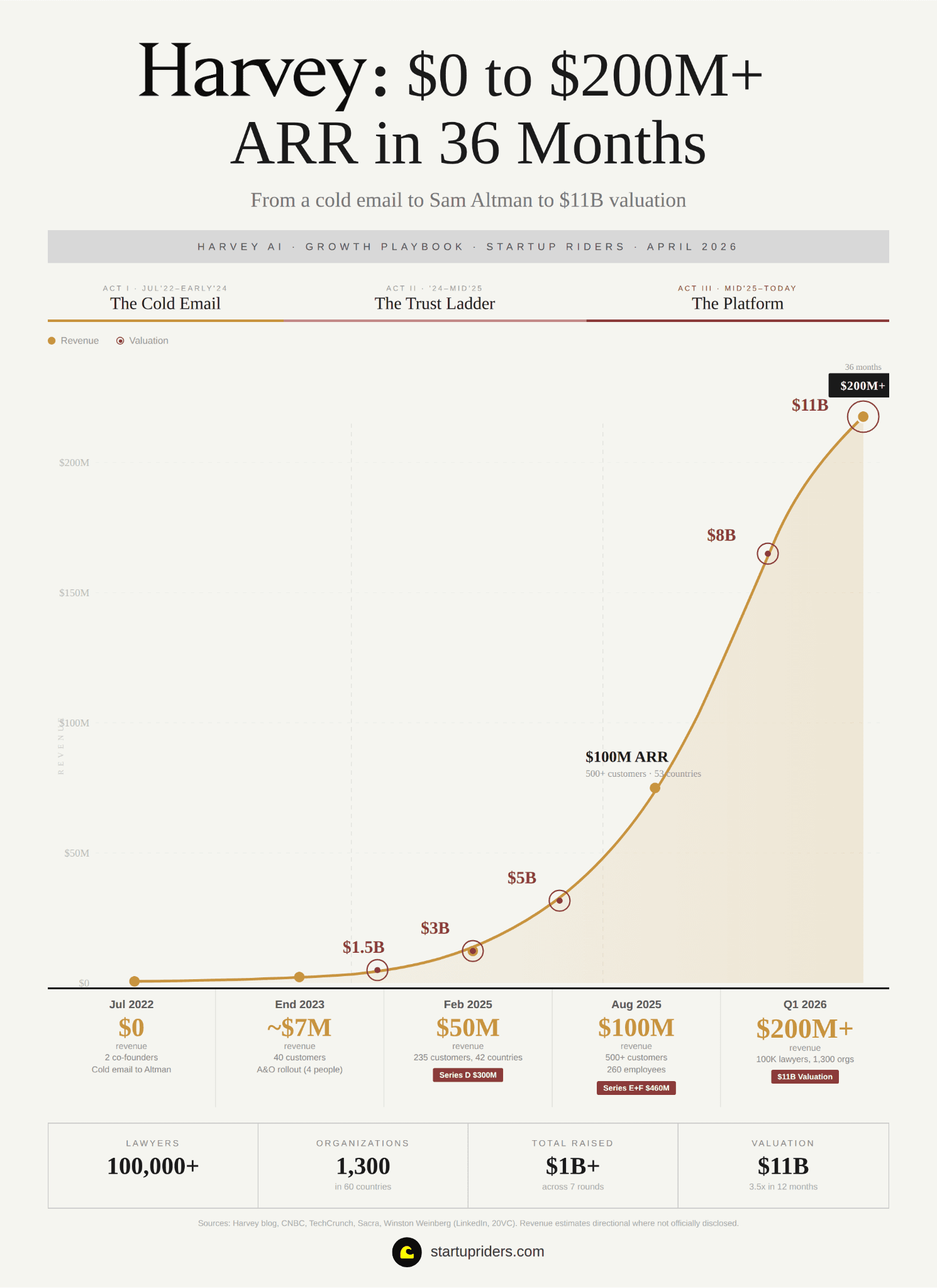
July 2022. An apartment in San Francisco. Two young men are writing an email with almost zero chance of being accepted by one of the world's most prestigious law firms.
Subject line: "Did you know how good GPT is at law?"
From: Winston Weinberg (securities litigator, O'Melveny & Myers) and Gabe Pereyra (DeepMind researcher).
To: Sam Altman.
The attachment to this email contained 100 legal questions compiled from r/legaladvice and the GPT-3 answers to those questions. 86 of the answers were found to be "valid" by lawyers specializing in landlord-tenant law. No one inside OpenAI had done this test.
The result? A presentation to OpenAI leadership on July 4, a seed investment, and the founding of Harvey AI, which is now valued at $11 billion.
36 months later: $200M ARR, about 460 employees, and nearly half of the 100 largest law firms in the U.S. on the customer list.
This isn't just a success story. It's a playbook for how vertical AI companies are built.
Act One: Prestige or Nothing
Most investors told them the same thing: Start with small firms. Target solo lawyers. Enter through the SME market.
Winston rejected that advice.
They knocked directly on Allen & Overy's door, one of the world's largest and most prestigious law firms. At that moment, Harvey's entire team was 4 people, and they were working from Airbnb.
The logic was extremely simple, but most founders miss it:
"If you win the trust of a few big firms, the rest will already see you as credible. So will their clients."
In professional services, trust is not a product feature; it is the product itself.
A&O reached a daily usage rate between 70 and 80 percent in the first stage of the pilot. 3,500 lawyers asked 40,000 questions before the firm made a commitment. The first 50 enterprise customers came through referrals from the law firms' own clients.
A similar question also comes up in legal tech discussions in Turkey: Should we target large firms first, or start with accessibility? Harvey's answer is clear; when you prove you can win the hard work, the easy work follows.
Act Two: Expand, Narrow, Repeat
Harvey's product strategy has become almost a template for vertical AI.
Legal work is divided into several core categories: drafting, document comparison, case law research, regulatory analysis, contract review, data room processing... Each has its own logic. A system that scans millions of pages of contracts in a due diligence process is not the same as a system that develops counterarguments to a lawsuit petition.
Harvey's approach can be summarized in two steps:
First expand: Build separate, deeply optimized systems for each workflow. Place lawyers alongside engineers. The answers to questions like "How do you create a disclosure schedule?" or "What is the market-standard clause?" are stored in process data; they are in no training set. They live inside law firms.
Then narrow: Combine all these systems into a single interface. The AI routes the user to the right tool based on the question. No menus, no friction. If you ask a case law question, the system suggests a LexisNexis connection; if you upload a merger agreement, it triggers the due diligence workflow.
The result? Among users who adopt more than four product modules, the daily active usage rate is 75 percent; that figure is now approaching 85 percent.
Act Three: From Selling Software to Selling Work
This is where Harvey's most radical transformation begins.
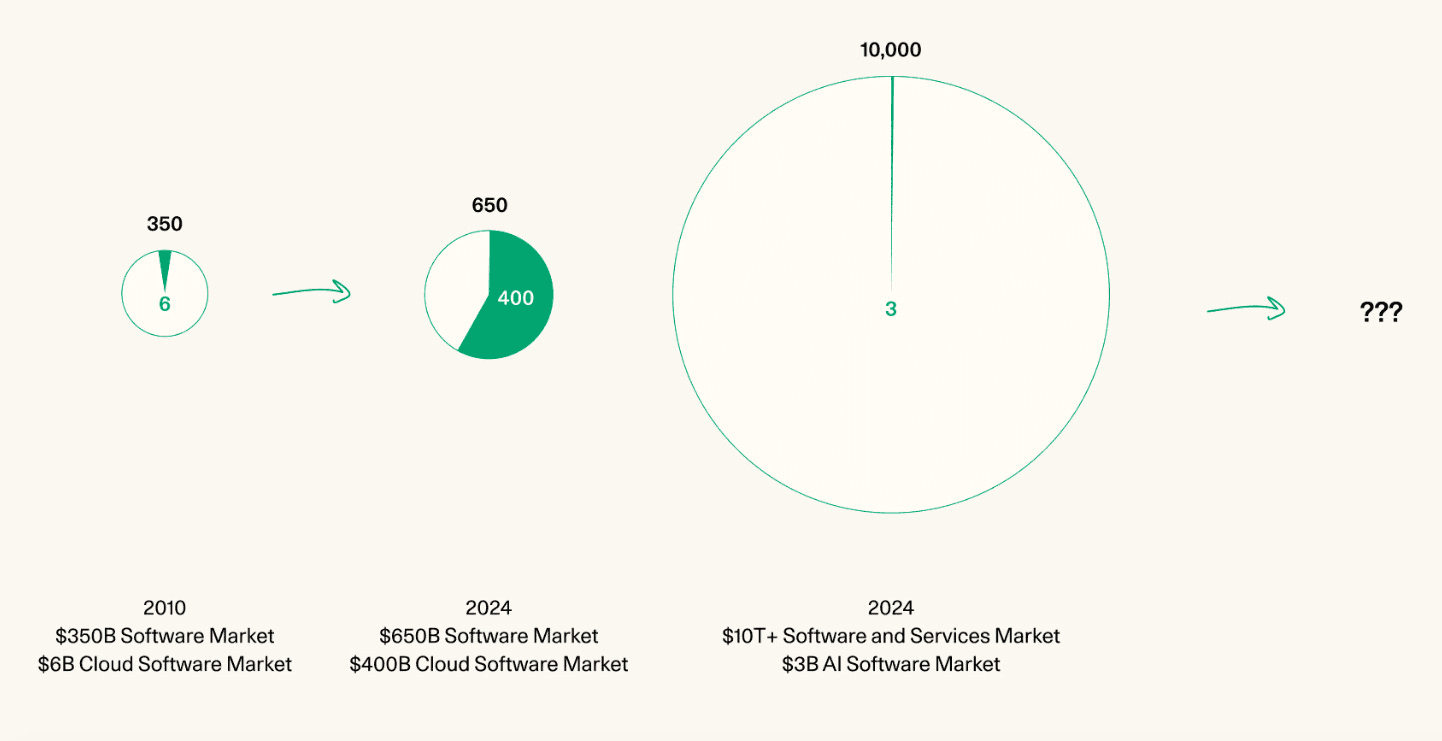
Traditional SaaS companies sell seats. Harvey goes one step further: it sells work.
Here's how it works: Harvey develops a custom AI solution together with a law firm. That firm sells this solution to its own clients. With the revenue-sharing model, Harvey also takes a share of that sale.
A concrete example: The formation and structuring processes of a private equity fund (fund formation) are automated with a custom workflow built by a law firm on Harvey. The firm sells this product to its client. The budget comes not from the technology spending line item (millions), but from the professional services spending line item (billions).
This difference looks small, but the consequences are enormous: the incentive structure of the law firm is reversed. The question "How little can I pay Harvey?" turns into "How much work can I sell through Harvey?"
The Overlooked Metric: GRR
Harvey's CEO, Winston Weinberg, defines the biggest mistake investors in the AI sector make as follows:
"Most investors look only at net new ARR. They ignore Gross Revenue Retention. That's a big mistake."
When you look at retention data, the picture becomes clear: within 12 months after deployment at Harvey, the median number of seats doubles. Weekly active users have quadrupled year over year.
For companies that have surpassed $100M ARR, the real test begins here. Not winning new customers, but retaining and growing existing ones. Harvey's numbers show that it has passed this test.
Competition: A Two-Player Race
The enterprise legal tech market is rapidly becoming a two-horse race: Harvey and Legora.
While Harvey leads with about $200M ARR, Legora is catching up quickly despite starting a year later.
They differ in technical positioning: Harvey runs an orchestration layer on multiple foundation models (OpenAI, Anthropic, Google, Mistral) and selects the most suitable model for the task. Legora, by contrast, is built mainly on Claude and optimized for speed and large-document processing.
Among Harvey's hard-to-copy advantages are its LexisNexis partnership (case law accessible from within the product), custom workflows built by 18,000 users, and a sales team drawn from legacy large law firms.
Watching this competition is also critical for Turkey, because both companies are shaping their relationships with Turkish users.
4 Takeaways from Harvey's Story for the Turkish Legal World
1. Trust is the distribution channel. Prestige hierarchy is real in the legal business world. Winning the biggest firms convinces the rest of the market.
2. AI doesn't change jobs, it changes business models. Harvey shows its most striking effect not in individual productivity gains, but in redefining the economic relationship law firms have with their clients.
3. Without domain experts, there is no product. The lawyers at Harvey are not sales closers, but the product's architects. Only they know how each workflow operates and what counts as a "good" output.
4. Retention comes before everything. Not acquiring new users, but existing users coming back and expanding; that is the real sign of sustainable growth.
Harvey's story disproves the narrative that AI will "finish off" the legal sector. It is transforming law; and in a way that favors the lawyers who best understand and steer that transformation.
That is exactly why LANT exists.
